Engine Fire Scare Forces Delta Flight Back to São Paulo Moments After Takeoff
A routine international departure turned into a heart-stopping ordeal when flames shot from the engine of a Delta Air Lines aircraft just moments after takeoff from Brazil. Passengers aboard the wide-body jet screamed for the pilots to “turn around” as sparks and bursts of fire lit up the night sky outside their windows.
What could have spiraled into tragedy instead became a testament to modern aviation safety standards and disciplined cockpit training. The flight crew quickly declared an emergency, shut down the affected engine, and safely returned the aircraft to the runway at São Paulo/Guarulhos International Airport.
All 272 passengers and 14 crew members walked away unharmed.
A Frightening Start to an International Journey
Delta Flight 104, operated by an Airbus A330-300, had just taken off from São Paulo on a scheduled journey to Hartsfield-Jackson Atlanta International Airport in Georgia — the primary hub of Delta and one of the busiest airports in the world.
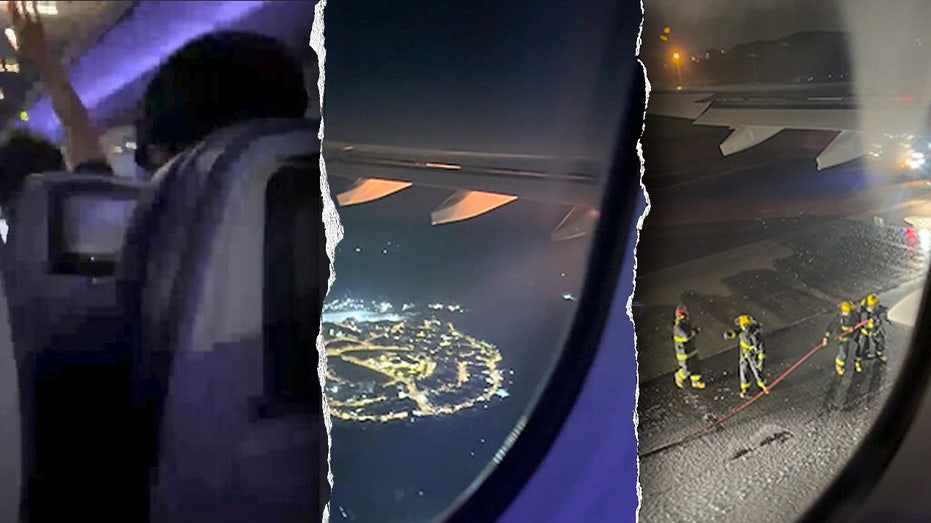
Shortly after becoming airborne, passengers noticed something alarming: streaks of sparks and visible flashes coming from the aircraft’s left engine. Videos recorded from cabin windows show glowing embers trailing behind the engine as the jet climbed into the sky.
Inside the cabin, fear spread quickly. Shouts of “Turn around!” could be heard as passengers fully grasped what appeared to be a serious malfunction happening in real time.
Within minutes, the pilots took decisive action.
Professional Response in the Cockpit
According to Delta, the flight crew observed an indication of a mechanical issue with the left engine and immediately followed established emergency procedures. In commercial aviation, engine irregularities are treated with the utmost seriousness, especially during critical phases of flight like takeoff and initial climb.
The pilots:
- Declared an emergency
- Shut down the affected engine
- Stabilized the aircraft using the remaining engine
- Coordinated with air traffic control for an expedited return
- Prepared for a priority landing
Modern commercial airliners like the Airbus A330 are certified to operate safely on a single engine. In fact, aircraft undergo rigorous testing to ensure they can climb, cruise, and land securely even after losing full power from one engine. These standards are enforced globally and overseen in the United States by the Federal Aviation Administration (FAA).
The ability to fly safely on one engine is not an emergency improvisation — it is a critical design feature built into the aircraft from day one.
Emergency Crews Standing By
As Delta Flight 104 circled back to São Paulo, airport rescue services prepared for a potential emergency landing. Aircraft Rescue and Firefighting (ARFF) teams were positioned along the runway, a standard safety protocol for in-flight mechanical issues.
According to the FAA’s Aircraft Rescue and Firefighting guidelines, airports serving large commercial aircraft must maintain rapid-response teams capable of handling fires, fuel spills, and emergency evacuations within minutes.
When the A330 touched down safely, emergency personnel approached the aircraft and sprayed foam or fire retardant as a precaution. Video footage circulating online shows rescue vehicles surrounding the jet as it came to a stop.
Inside the cabin, the mood shifted from panic to overwhelming relief. Passengers erupted into cheers and applause, grateful for the safe outcome.
No Injuries Reported
Remarkably, no injuries were reported among passengers or crew. The successful return highlights the layered redundancy built into commercial aviation safety.
Delta later confirmed in a statement that the aircraft returned “following an indication of a mechanical issue with the aircraft’s left engine,” and emphasized that flight crews followed established procedures.
Passengers were escorted back to the terminal and later rebooked on alternate flights.
The airline added that the safety of customers and crew remains its top priority — a statement that in this instance bore out in real-world results.
Understanding Engine Flames: What Likely Happened?
To the average traveler, seeing flames from a jet engine is terrifying. But aviation experts note that visible sparks or bursts of flame do not necessarily mean catastrophic engine failure.
Several scenarios can produce visible flames during a malfunction:
- Compressor stall — a temporary disruption in airflow through the engine
- Fuel ignition irregularity
- Mechanical damage to internal turbine components
- Bird strike ingestion
While the specific cause of this incident has not yet been publicly detailed, such events typically trigger cockpit warnings immediately. Pilots are trained extensively in simulator environments to handle exactly these kinds of emergencies.
The National Transportation Safety Board (NTSB) or Brazilian aviation authorities could potentially review the incident, depending on jurisdiction and severity. Mechanical events that result in emergency returns are carefully documented and analyzed to prevent recurrence.
The Strength of American Aviation Standards
Although this incident occurred in Brazil, Delta is a U.S.-based airline, and American aviation safety culture played a key role in the outcome.
The United States maintains one of the most robust aviation oversight systems in the world. The FAA sets strict rules governing:
- Aircraft maintenance intervals
- Pilot training and simulation requirements
- Emergency procedure compliance
- Aircraft airworthiness directives
Commercial pilots in the United States undergo recurrent simulator training every six to twelve months, where they repeatedly practice engine failures during takeoff — widely considered one of the most demanding scenarios in aviation.
In other words, what terrified passengers was a scenario Delta pilots have rehearsed countless times under controlled conditions.
About the Aircraft: Airbus A330-300
The aircraft involved, the Airbus A330-300, is a long-haul, twin-engine wide-body jet used by airlines across the globe. It typically carries between 250 and 300 passengers and is designed specifically for high-efficiency transcontinental and intercontinental travel.
The A330 family has accumulated millions of flight hours worldwide. Like all modern commercial aircraft, it is built with redundant systems designed to prevent a single-point failure from becoming catastrophic.
Engine technology has advanced dramatically over the last several decades. Today’s turbofan engines undergo exhaustive testing, including:
- Bird ingestion tests
- Blade containment tests
- Extreme weather simulations
- Full-power endurance runs
Even so, no machine built by human hands is entirely immune to mechanical issues. What separates safe systems from dangerous ones is preparation, redundancy, and rapid response — all of which were evident here.
Passenger Psychology: Fear at 30,000 Feet
Moments like this underscore a reality of modern travel: millions of Americans fly safely each day, but when something goes wrong, the psychological impact is profound.
Inside the cabin, passengers see flames or hear unusual noises without full situational awareness. The cockpit, however, relies on detailed diagnostics and real-time instrumentation. What may look chaotic from a seat by the window is often already being methodically addressed by trained professionals.
The cheers heard after landing reflect not just relief but trust — trust that American carriers maintain high standards and that flight crews are prepared to protect those in their care.
Rebooking and Operational Impact
After returning to the gate, passengers were taken back into the terminal and rebooked on alternate flights. International disruptions can pose logistical challenges, particularly on long-haul routes with limited daily departures.
Airlines typically activate contingency plans in such situations, including:
- Arranging hotel accommodations if necessary
- Reassigning aircraft
- Dispatching maintenance crews for inspection
- Coordinating with airport authorities for rapid turnaround
Delta’s global network and its major hub in Atlanta likely helped minimize extended delays for affected travelers.
The Bigger Picture: Aviation Remains the Safest Mode of Travel
Despite the alarming visuals, events like this demonstrate something critical: commercial air travel remains extraordinarily safe.
Statistically, flying is safer than driving by a wide margin. Each year, tens of millions of flights operate globally with the vast majority arriving without incident. Emergency returns, while dramatic, often reflect systems working exactly as designed.
In aviation, a “safe failure” — where a problem is identified, contained, and resolved without injury — is considered a success of the safety architecture.
That is precisely what occurred aboard Delta Flight 104.
Accountability and Investigation
Federal authorities and airline maintenance teams will likely conduct a thorough inspection of the engine and aircraft systems to determine the root cause. Aviation investigations focus not on blame but on prevention.
If necessary, manufacturers and regulators issue service bulletins or airworthiness directives to address potential systemic concerns across entire fleets.
This continuous feedback loop — incident, analysis, correction, improvement — is a hallmark of the American aviation model.
A Reminder of Calm Under Pressure
For the passengers aboard Flight 104, what began as a journey home turned into a brush with fear at altitude. But thanks to decisive action, layered safety systems, and well-trained aviation professionals, the incident ended not with tragedy — but with applause.
The men and women in the cockpit did exactly what they were trained to do. Emergency crews were positioned within minutes. Air traffic control cleared the way. Procedures were followed. Lives were protected.
That is not luck. That is discipline.
Your Source for Patriotic News
At Wake Up America News, we report on events that matter — and we recognize the strength of American aviation standards when they protect families at 30,000 feet.
This incident serves as a reminder that vigilance, training, and accountability remain pillars of U.S. aviation leadership. While no one wants to see flames outside their window mid-flight, the outcome proves an essential truth: when emergencies arise, American crews are ready.
And that preparedness makes all the difference.