A Daughter’s Viral Tribute as America Reclaims Deep Space
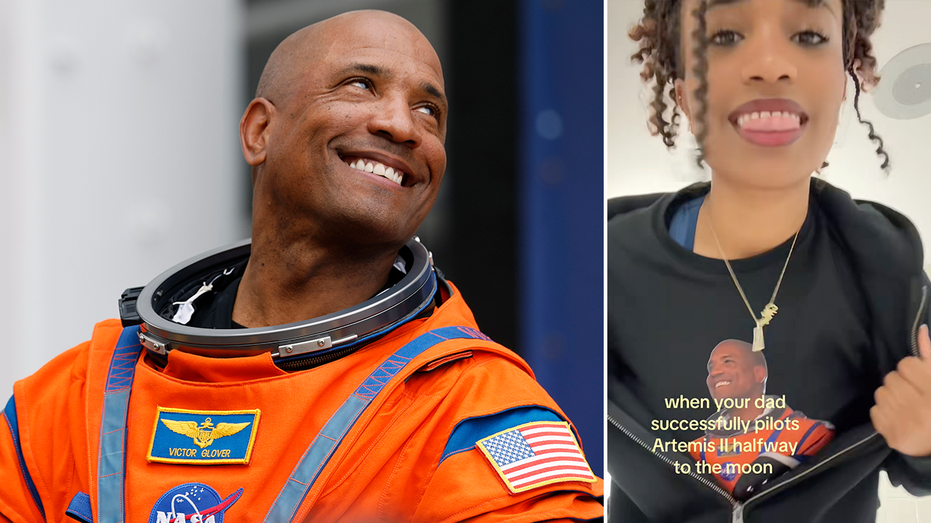
As the United States once again pushes boldly into deep space through NASA’s Artemis program, millions of Americans are being reminded that behind every historic mission are families who live the journey right alongside the astronauts. This week, that reality came into joyful focus when the daughter of Artemis II pilot Victor J. Glover captured the internet’s attention with a lighthearted tribute to her father’s monumental achievement.
While Artemis II streaked through space on its path around the moon, Maya Glover posted a playful video of herself dancing in a T-shirt featuring her father in a space suit. The caption read: “When your dad successfully pilots Artemis II halfway to the moon … & u forget the dance.” The short clip exploded across social media, racking up more than 21 million views across platforms.
But beyond the laughs and viral fame lies a deeper story — one about American excellence, generational pride, and the return of U.S.-led leadership in deep-space exploration.
The Artemis II Mission: America’s Return to the Moon
Artemis II represents a defining chapter in American space history. Managed by NASA, the Artemis program is designed to return humans to the moon for the first time since the final Apollo mission in 1972. Unlike Apollo, however, Artemis aims to establish a sustainable presence and lay groundwork for future missions to Mars.
Artemis II is the first crewed mission of the program and marks humanity’s return to deep space beyond low Earth orbit in over 50 years. Launched aboard NASA’s Space Launch System (SLS) — the most powerful rocket ever built — the crew is traveling in the Orion spacecraft. Their mission: fly around the moon and return safely to Earth in a 10-day flight test that will validate systems for future lunar landings.
The Artemis II crew includes:
- Reid Wiseman, Commander
- Victor Glover, Pilot
- Christina Koch, Mission Specialist
- Jeremy Hansen of the Canadian Space Agency
This mission is not just symbolic. It is operationally critical, testing life-support systems, propulsion, navigation, communication, and thermal protection capabilities needed to support sustained lunar missions.
Victor Glover: A Barrier-Breaking American Hero
Victor Glover’s presence on Artemis II is historic. A former U.S. Navy aviator and test pilot, Glover previously flew on Expedition 64 aboard the International Space Station. But Artemis II marks an even more groundbreaking milestone: he is the first Black astronaut to travel beyond low Earth orbit and journey into deep space toward the moon.
In a nation built on the principle that opportunity should expand with each generation, Glover’s achievement stands as both progress and proof. His flight is not about symbolism alone. It is about performance, discipline, and the hard-earned expertise required to pilot a spacecraft traveling nearly 25,000 miles per hour.
As pilot of Artemis II, Glover plays a central role in navigating the Orion spacecraft during high-stakes maneuvers, including the powerful burn that committed the mission to its lunar trajectory.
The “First Daughter of the Moon” Goes Viral
While NASA engineers monitored telemetry and Americans watched history unfold, Maya Glover celebrated in her own way. Dancing on camera in her father’s honor, she captured something refreshingly human in a moment of high-tech triumph.
Major corporate brands quickly noticed. Social media accounts for companies like Walmart and Spotify chimed in with playful comments. One account dubbed her the “First daughter of the moon,” a nickname that resonated instantly with viewers.
The viral response underscores how space exploration remains a uniquely American source of national unity. In a divided digital age, a daughter’s pride in her father’s accomplishment managed to cut through political noise and resonate across millions of screens.
What struck many viewers was not just the humor, but the authenticity. Her post reflected the reality that space missions aren’t just about rockets and data — they are about families who endure long training cycles, missed holidays, and the emotional strain that accompanies each launch.
A Cal Poly Student with a Front-Row Seat to History
Maya Glover is a student at California Polytechnic State University, an institution known for its strong engineering and STEM programs. Growing up in a household where aerospace was part of daily conversation clearly left its mark.
In a separate post, she shared childhood photos of herself building rockets in the garage while wearing her father’s aviator helmet. Her reflection was simple but powerful: the same child who once played at being an astronaut had now watched her dad launch aboard the most powerful rocket humans have ever built.
For millions of young Americans, particularly young girls interested in science and engineering, that image sends an unmistakable message: space exploration is not distant fantasy. It is a career path open to those willing to commit to excellence.
The Risks of Re-Entry: The Most Dangerous Phase
While celebration is well-deserved, the Artemis II mission is also a reminder that spaceflight remains inherently dangerous. The greatest challenge comes during re-entry.
As Orion returns to Earth, it will slam into the atmosphere at roughly 25,000 miles per hour. The spacecraft’s heat shield must endure temperatures nearing 5,000 degrees Fahrenheit — about half as hot as the surface of the sun.
Orion’s innovative heat shield uses advanced materials designed to absorb and dissipate enormous thermal energy. Engineers at NASA and contractors across the United States have spent years rigorously testing the system to ensure astronaut safety.
The mission is expected to conclude with a splashdown in the Pacific Ocean, where U.S. Navy recovery teams will retrieve the capsule — marking the safe completion of another major step toward permanent lunar operations.
The Bigger Picture: Why Artemis Matters
The Artemis program is not happening in isolation. China has publicly announced plans for its own lunar base ambitions through the China National Space Administration. The renewed global interest in the moon has strategic implications beyond exploration.
The lunar surface contains resources such as water ice, which could be converted into fuel and life-support systems for future missions. Establishing a sustained presence on the moon positions the United States at the forefront of space commerce, security, and innovation.
Artemis also supports domestic industry. The Space Launch System alone involves contractors and suppliers across nearly every state, supporting thousands of American jobs. Universities, research labs, and private companies are all contributing to a growing space economy that promises technological breakthroughs with downstream benefits here on Earth.
From GPS advancements to improved materials science and telecommunications, America’s past space investments have repeatedly paid off. Artemis aims to continue that legacy.
A New Apollo Moment for a New Generation
Many Americans recall the Apollo era as a time of bold ambition and national pride. Today’s younger generation experiences that sense of wonder largely through screens — livestreams, social feeds, and viral clips like Maya Glover’s dance.
Yet the significance remains the same.
When Americans lead in space, we demonstrate our ability to innovate, collaborate, and overcome seemingly impossible odds.
Artemis II bridges past and future. It honors the Apollo trailblazers while proving that modern America still possesses the talent and determination to venture beyond Earth’s orbit.
Victor Glover’s journey symbolizes opportunity realized. Maya Glover’s viral moment symbolizes inspiration passed forward. Together, they represent something bigger than internet fame — they represent generational achievement in action.
The Human Side of American Achievement
Too often, headlines focus solely on technical milestones. But missions like Artemis II are built on deeply human foundations:
- Countless hours of astronaut training
- Engineers running simulations through the night
- Families supporting loved ones through years of preparation
- Communities rallying behind hometown heroes
The viral video resonated because it captured that reality in seconds. It reminded Americans that historic achievements are powered not just by machinery but by courage, faith, and family.
The public’s overwhelming positive reaction suggests that Americans still crave stories of national excellence — stories that unite rather than divide.
Inspiration That Reaches Beyond the Launch Pad
As Orion completes its journey and prepares for re-entry, the spotlight may eventually shift from social media back to mission data and technical debriefs. But the symbolic impact of Artemis II — and of a daughter proudly celebrating her father — will endure far longer.
Young students watching today may one day become the engineers who design lunar habitats or the astronauts who plant American boots back on the moon’s surface. Some may even cite moments like Maya Glover’s viral tribute as the spark that first ignited their curiosity.
In that sense, Artemis II is more than a flight test. It is a cultural milestone reminding Americans that exploration is part of our national DNA.
America’s Journey Continues
As the Orion capsule prepares to splash down and conclude its successful 10-day mission, the United States can take pride in what Artemis II represents: leadership, resilience, and family.
Victor Glover’s steady hand at the controls, backed by decades of training and experience, demonstrates the strength of America’s astronaut corps. Maya Glover’s joyful tribute shows the world that behind every great mission stands a generation inspired to reach even higher.
In an era often dominated by negativity, this story offers something refreshingly positive — a reminder that America still dares to explore, still invests in greatness, and still inspires the world.
The moon may be 238,000 miles away, but moments like these bring the journey home. At Wake Up America News — Your Source for Patriotic News — we celebrate not just the science of missions like Artemis II, but the spirit that drives them forward.
The next chapter of American exploration is unfolding in real time. And if this week is any indication, the next generation is already dancing in anticipation.