NYC Councilman Chi Ossé Arrested During Brooklyn Eviction Protest, Raising Fresh Questions About Law, Order, and Property Rights
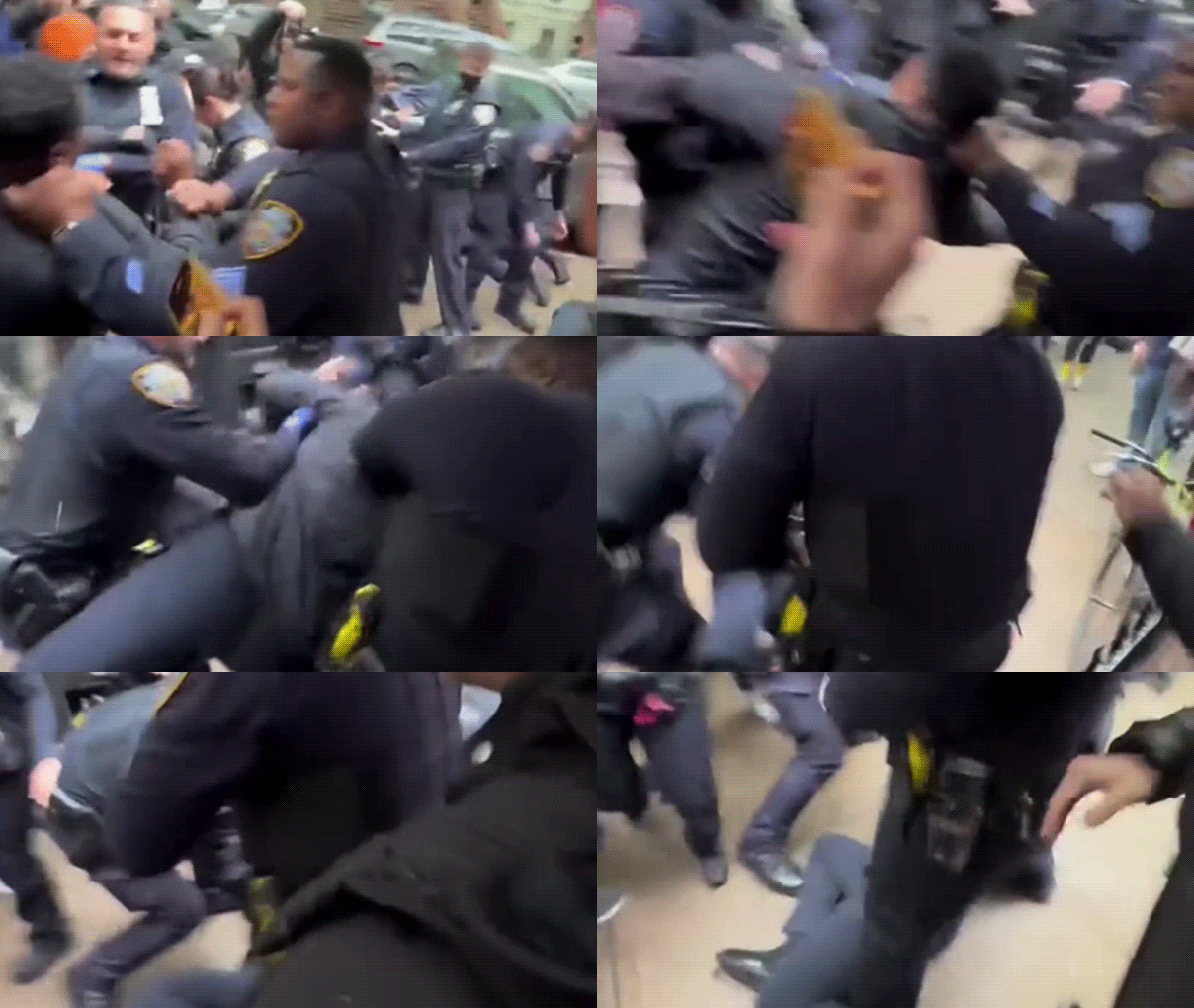
A chaotic scene unfolded in Brooklyn this week when New York City Council Member Chi Ossé was taken into custody during a protest over a controversial eviction. Video circulating online shows officers wrestling the 28-year-old lawmaker to the ground as bystanders shouted objections, with one man heard yelling, “That’s a councilman!”
The incident has quickly become a flashpoint in the city’s ongoing debates over housing policy, policing, deed theft, and the limits of elected officials’ involvement in law enforcement matters. Ossé, described in reports as an ally of New York City Mayor Zohran Mamdani, was arrested alongside three others and charged with obstruction of governmental administration and disorderly conduct, according to police.
At the heart of the dispute is a decades-long Brooklyn resident facing eviction amid allegations involving deed fraud. Supporters see the protest as a stand against displacement. Law enforcement officials maintain they were simply carrying out a court-ordered eviction and enforcing the law.
What Happened in Brooklyn
The arrest occurred in the Bedford-Stuyvesant neighborhood of Brooklyn, commonly referred to as Bed-Stuy, an area that has experienced dramatic demographic and economic shifts in recent years. According to the New York City Police Department (NYPD), officers were present alongside the New York City Sheriff’s Office and NYC Marshals to execute a judge-signed eviction order.
Police say the marshals had a lawful court order authorizing the eviction of a woman who had reportedly lived in her home for six decades. Officials also indicated they were attempting to determine whether an individual described as a ward of the state of Georgia—who was supposed to reside in Georgia but had allegedly not been there for years—was at the Brooklyn residence.
When authorities arrived, they encountered protesters blocking access to the building. According to an NYPD spokesperson, two individuals were initially arrested for blocking the gate at the property. Shortly after, Ossé allegedly pushed past officers, moved in front of the gate, and blocked access himself.
Police contend that Ossé resisted efforts to restrain him, flailing his arms and resisting hand placement, which led officers to take him to the ground to complete the arrest. They maintain that the takedown was carried out within department guidelines due to limited space between the gate and the officers.
Ossé was charged with obstruction of governmental administration and disorderly conduct. Three others were also arrested.
Ossé’s Response and Allegations of Excessive Force
Following his release, Ossé sharply criticized the officers involved in his arrest. He announced plans to file a misconduct complaint and encouraged others taken into custody to do the same. According to Ossé, at least two other individuals reported concussions after the incident.
“I would hope to see that they are held accountable,” he said, urging scrutiny of the officers’ histories and calling on the police commissioner to take the matter seriously.
Video clips circulated online show a tense scene, with officers attempting to control protesters near the building’s entrance. While supporters argue the footage depicts unnecessary force, law enforcement sources point to body-worn camera recordings they say show Ossé interfering with official duties.
The NYPD’s patrol guidelines and use-of-force policies are publicly documented, and arrests for obstruction of governmental administration are not uncommon during protests where access to property or official operations is blocked.
The Legal Basis for the Eviction
Evictions in New York City require judicial approval. The New York State Unified Court System, which oversees housing matters through its NYC Housing Court, must issue an order before a marshal can remove a tenant or occupant.
In this case, police said NYC Marshals arrived with a “signed order from a judge.” Under New York law, marshals are authorized to enforce court-ordered evictions once proper legal procedures have been exhausted.
The role of NYC Marshals is distinct from that of the NYPD. Marshals are civil enforcement officers appointed to enforce judgments and orders, including evictions. Information about their authority and responsibilities can be found through the New York City Department of Finance, which oversees their appointment and regulation.
While protests around evictions are not uncommon—especially in gentrifying neighborhoods—the law is clear that physical obstruction of lawful enforcement actions can result in arrest.
Understanding Deed Theft in New York City
Central to the controversy are allegations of deed fraud or “deed theft.” Ossé’s office stated that “Black displacement is happening right now in Bed-Stuy” and described his constituent as one of many Black homeowners battling deed theft in Brooklyn.
The New York City Department of Finance defines deed theft as a situation in which criminals record fraudulent deeds, mortgages, or liens against a property without the owner’s knowledge or consent.
According to the department, seniors, immigrants, and people of color are particularly vulnerable. Fraudsters may trick homeowners into signing documents through deception or forge paperwork to unlawfully claim ownership. In some cases, victims only discover the fraud when facing foreclosure or eviction.
City officials have attempted to increase awareness and enforcement in recent years. Programs allow property owners to sign up for property record alerts when changes are filed against their property.
However, whether deed fraud was conclusively established in this particular case remains unclear from public statements. What is clear is that a court ultimately granted an eviction order—suggesting that, from the judiciary’s standpoint, the legal threshold had been met.
Political Undercurrents in a Deeply Divided City
Ossé, who represents Brooklyn’s 36th Council District and serves on the New York City Council, has built a profile as a Democratic socialist and vocal critic of displacement in historically Black neighborhoods.
He has also been described as an ally of New York City Mayor Zohran Mamdani. In recent years, New York politics have been shaped by intense debates over housing affordability, policing, and gentrification.
Many progressive lawmakers argue that rising property values and aggressive real estate tactics are pricing long-time residents out of neighborhoods like Bed-Stuy. On the other hand, critics contend that undermining court-ordered evictions and interfering with law enforcement weakens the rule of law and property rights—foundational pillars of the American system.
These tensions are amplified by broader challenges in New York City, which recently saw population declines across multiple income levels. Economic migration, high taxes, and public safety concerns have fueled debate about the city’s direction.
Obstruction of Governmental Administration: What the Charge Means
The charge of obstruction of governmental administration typically applies when an individual intentionally interferes with a public servant performing an official duty. In New York, this can include physically blocking officers or resisting lawful enforcement actions.
Legal experts note that the definition hinges on intent and physical interference. Peacefully observing or verbally criticizing police action does not ordinarily qualify; stepping between officers and a lawful objective, however, may cross that line.
If prosecutors pursue the case, they will likely rely heavily on body-worn camera footage and testimony to establish whether Ossé’s conduct met that threshold.
The Role of Elected Officials at Protest Scenes
The arrest of a sitting council member also raises an important question: what role, if any, should elected officials play in real-time law enforcement events?
Public officials are often present at demonstrations tied to issues affecting their constituents. They may advocate, observe, or even attempt to mediate. But when they step into ongoing enforcement activity—particularly in physical proximity to officers—the line between advocacy and interference can blur.
Across the country, lawmakers have at times been arrested during protests. While such arrests can galvanize supporters, they also test public trust in the principle that no one is above the law.
Supporters of Ossé argue he was standing up for vulnerable residents in the face of displacement. Critics argue that elected officials, especially lawmakers, should respect court orders and legal procedures—even when they disagree with the outcome.
Bed-Stuy and the Broader Gentrification Debate
Bedford-Stuyvesant has long been a historic center of Black culture in Brooklyn. Over the last two decades, however, the neighborhood has experienced substantial demographic shifts as new development and rising housing prices transform the area.
For some families, skyrocketing property values represent generational wealth. For others—particularly renters and those vulnerable to fraud or financial pressure—the changes can result in hardship and displacement.
Housing activists often cite deed theft as one tool used by bad actors to exploit elderly homeowners. Law enforcement and prosecutors in Brooklyn have pursued cases involving fraudulent transfers, but the legal process to unwind such schemes can be slow and complex.
At the same time, property rights remain a cornerstone of American law. Courts are tasked with weighing evidence and applying statutes fairly—regardless of political pressure.
Police Accountability and Public Confidence
Ossé’s intention to file a misconduct report will likely trigger a review within the NYPD’s internal oversight framework. Police departments across the country have adopted body-worn cameras in part to enhance transparency and accountability in situations like this.
The release—or withholding—of body camera footage often shapes public perception. If footage shows clear resistance or obstruction, it could bolster the department’s justification. If it demonstrates excessive force beyond what was necessary, it could strengthen calls for discipline.
For residents already skeptical of city leadership or police practices, the outcome will matter. In a city as politically polarized as New York, trust in institutions—courts, police, and elected officials—is fragile and constantly tested.
The Bigger Picture: Law, Order, and Compassion
This incident underscores a fundamental tension in American cities: how to balance compassion for struggling residents with respect for lawful court processes and property rights.
Evictions are often painful and politically charged. But when a judge signs an order after legal proceedings, enforcement becomes more than a policy debate—it becomes an issue of legal compliance.
At the same time, allegations of deed fraud demand serious investigation. If criminal actors are exploiting elderly or minority homeowners, law enforcement has a duty to prosecute those cases aggressively.
What cannot be lost in the political crossfire is the principle that the rule of law applies equally. Elected officials, activists, and officers alike must operate within legal boundaries. America’s constitutional system depends on it.
What Happens Next
The charges against Ossé and the others arrested will proceed through the criminal justice system. Prosecutors will evaluate the evidence, including body camera footage and eyewitness video.
Separately, any misconduct complaints filed by Ossé or other arrestees will be reviewed according to NYPD disciplinary procedures.
Meanwhile, the broader controversy over displacement, deed fraud, and housing security in Brooklyn is unlikely to diminish. Housing affordability remains one of the most contentious issues in New York politics, and future clashes between activists and authorities are almost certain.
For Americans watching from across the country, the Brooklyn arrest serves as a reminder of the stakes involved in urban governance. Compassion and community matter. So do property rights and lawful process.
In a nation built on ordered liberty, both must coexist. And when they collide on city streets, the entire country pays attention.