Minor Fire Aboard USS Dwight D. Eisenhower Highlights Readiness and Rapid Response at Norfolk Naval Shipyard
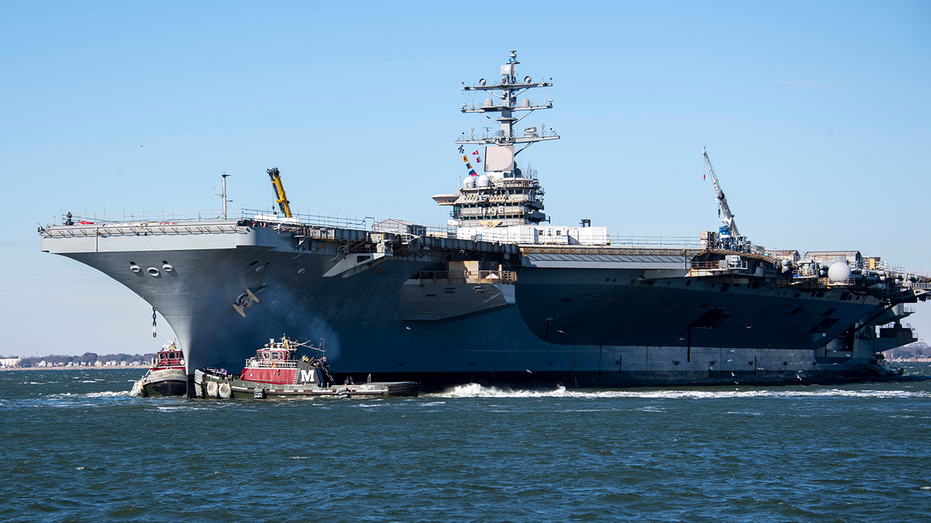
Three U.S. Navy sailors sustained minor injuries Tuesday after a small fire broke out aboard the aircraft carrier USS Dwight D. Eisenhower (CVN-69) while the ship was undergoing scheduled maintenance at Norfolk Naval Shipyard in Portsmouth, Virginia.
According to a Navy spokesperson, the fire was quickly contained and extinguished by the ship’s crew and shipyard personnel, who responded immediately in accordance with established safety and emergency protocols. The injured sailors were treated by the ship’s onboard medical team and returned to full duty, underscoring both the professionalism and resilience of America’s sea service.
An investigation into the cause and origin of the fire is ongoing. While the incident appears to have been limited in scope, it serves as a reminder of the complexity of maintaining floating cities that project American power around the globe.
A Rapid, Professional Response
The USS Dwight D. Eisenhower, named after America’s 34th president, Dwight D. Eisenhower, is one of the Navy’s Nimitz-class nuclear-powered aircraft carriers. These carriers represent the pinnacle of naval engineering and serve as the centerpiece of U.S. carrier strike groups.
When the fire broke out aboard the ship, both sailors assigned to the carrier and civilian shipyard personnel took immediate action. According to Navy officials, the blaze was “immediately contained and extinguished” by trained responders following established damage control procedures.
Firefighting at sea—or even in port—requires precise coordination. Aircraft carriers are essentially small cities, housing thousands of sailors, complex machinery, aviation fuels, weapons systems, and propulsion reactors. Safety protocols are drilled repeatedly to ensure any emergency can be handled swiftly.
The three sailors who suffered minor injuries were treated aboard ship and returned to duty the same day. Their quick recovery speaks to both the limited nature of the fire and the readiness of Navy medical teams.
Ongoing Investigation
As is standard practice following any shipboard incident, the Navy has launched an investigation to determine the source and cause of the fire. At this stage, officials have not publicly identified where aboard the vessel the incident occurred.
Maintenance periods, known as “availabilities,” involve significant industrial work. Systems are opened, inspected, repaired, and upgraded. Temporary power sources, welding operations, and heavy machinery can introduce additional fire risks—risks that shipyards are specifically trained to mitigate.
The Navy has not announced whether the incident will impact the carrier’s maintenance timeline. Officials say it remains unclear if the current availability will be extended.
The Role of Norfolk Naval Shipyard
Norfolk Naval Shipyard (NNSY), located in Portsmouth, Virginia, is the Navy’s oldest shipyard, dating back to 1767. Today, it serves as a major repair and overhaul facility for aircraft carriers and submarines of the U.S. Atlantic Fleet.
The shipyard performs complex industrial maintenance that ensures Navy vessels remain ready to defend American interests around the world. This includes:
- Reactor maintenance for nuclear-powered vessels
- Upgrades to combat systems and radar arrays
- Hull repairs and modernization
- Propulsion system overhauls
- Crew habitability improvements
The collaboration between uniformed sailors and civilian shipyard experts is essential to sustaining America’s global naval presence. Tuesday’s swift response highlights the professionalism of both groups.
From the Red Sea to the Shipyard
The USS Dwight D. Eisenhower has been moored at Norfolk Naval Shipyard for more than a year following a demanding nine-month deployment to the Red Sea in 2023.
During that deployment, the carrier and its strike group were tasked with defending international shipping lanes and U.S. interests against drone and missile threats launched by Iranian-backed Houthi militants. The Houthis, formally known as Ansar Allah, are a rebel group operating in Yemen. You can read more about the group’s background at Britannica’s overview of the Houthi movement.
The Red Sea is one of the world’s most critical maritime corridors, connecting the Mediterranean Sea to the Indian Ocean via the Suez Canal. Disruptions in this region can have global economic consequences, impacting energy markets and international trade.
While deployed, the Eisenhower Carrier Strike Group faced repeated aerial threats, including armed drones and missiles. U.S. Navy warships intercepted and destroyed numerous hostile projectiles, demonstrating the unmatched capabilities of American naval power.
The deployment reinforced a fundamental truth: without strong, forward-deployed U.S. forces, adversaries are emboldened. With them, shipping lanes stay open and America’s allies remain secure.
Planned Maintenance and Modernization
Following its extensive combat deployment, the USS Dwight D. Eisenhower entered a planned incremental availability period. According to the U.S. Navy, this maintenance includes comprehensive work on:
- Propulsion systems
- Combat systems
- Aviation support capabilities
- Crew living quarters
Aircraft carriers operate under some of the most demanding conditions in the U.S. military. They must launch and recover aircraft around the clock, maintain nuclear propulsion systems safely, and integrate advanced radar and missile defense systems.
Modernization efforts ensure that even older carriers in the Nimitz class remain capable of countering 21st-century threats. These updates extend service life while preserving America’s decisive military edge.
The Eisenhower, commissioned in 1977, is one of the longest-serving aircraft carriers in the fleet. Maintaining her combat effectiveness is both a strategic necessity and a tribute to decades of service.
The Strategic Importance of Aircraft Carriers
Aircraft carriers like the Eisenhower are not just warships—they are strategic instruments of national power. A single carrier strike group can:
- Conduct sustained air operations
- Project power deep inland without reliance on foreign bases
- Deter adversaries through visible presence
- Provide humanitarian assistance in crises
The Nimitz-class carriers serve as floating airbases, capable of launching fighter jets, surveillance aircraft, and electronic warfare platforms. Their mobility allows the U.S. to respond rapidly to emerging threats without waiting for diplomatic clearance to use overseas airfields.
At a time when competitors like China are expanding their naval fleets, maintaining America’s existing carrier force is critical. Carrier modernization ensures that the United States Navy remains the world’s premier maritime power.
Safety Lessons and Operational Resilience
While Tuesday’s fire was small and swiftly extinguished, any shipboard incident is treated with seriousness. History has shown that even minor lapses during maintenance periods can escalate if not properly managed.
The fact that this fire was contained quickly reflects improved training and oversight. Since previous high-profile shipyard fires elsewhere in the fleet, the Navy has implemented enhanced safety protocols and mandatory training reforms designed to reduce risk during maintenance availabilities.
Key improvements over recent years have included:
- Stricter hot-work monitoring policies
- Improved fire watch standards
- Enhanced coordination between sailors and contractors
- Advanced fire detection technologies
These measures appear to have paid off in Tuesday’s incident, where rapid detection and immediate response prevented any significant damage.
Mission Readiness Remains the Priority
The Navy has not indicated any lasting operational impact to the USS Dwight D. Eisenhower. Whether the current maintenance period will be extended as a precaution remains under review.
However, there is no indication at this time that the carrier’s long-term readiness has been compromised.
America’s adversaries closely monitor the status of U.S. warships. Demonstrating transparency about minor incidents—while simultaneously showcasing competent crisis response—sends a clear message: the U.S. Navy remains disciplined, capable, and prepared.
A Symbol of American Strength
For nearly five decades, the USS Dwight D. Eisenhower has sailed across the globe in defense of American interests. From the Persian Gulf to the Red Sea and beyond, the carrier has served as a visible symbol of American strength.
Her recent deployment demonstrated the vital role carriers play in countering asymmetric threats such as drones and missile attacks from non-state actors backed by hostile regimes.
Now undergoing routine maintenance, the ship continues to represent the industrial strength and logistical sophistication that underpin American military dominance.
Naval power is not just about the number of ships afloat—it is about the ability to sustain and modernize them for future fights.
The Bigger Picture
Incidents like this week’s fire often generate concern, but they also highlight the complexity of maintaining the world’s most powerful Navy. Keeping a nuclear-powered aircraft carrier mission-ready requires constant vigilance, technical excellence, and disciplined crews.
The Eisenhower’s sailors demonstrated professionalism under pressure. Norfolk Naval Shipyard workers demonstrated their expertise and readiness. And the Navy’s swift communication underscores accountability.
At a time of global instability—from Middle Eastern flashpoints to Indo-Pacific tensions—America cannot afford complacency. Strong maintenance, rapid emergency response, and continuous modernization are not bureaucratic details; they are strategic imperatives.
The USS Dwight D. Eisenhower will sail again. And when she does, she will continue to carry forward a proud legacy of service, projecting freedom wherever the American flag flies.
Wake Up America News will continue monitoring developments as the Navy completes its investigation and provides updates on the ship’s maintenance status.