Artemis II Crew Pushes Forward as Minor Toilet Issue Highlights the Realities of Deep Space Travel
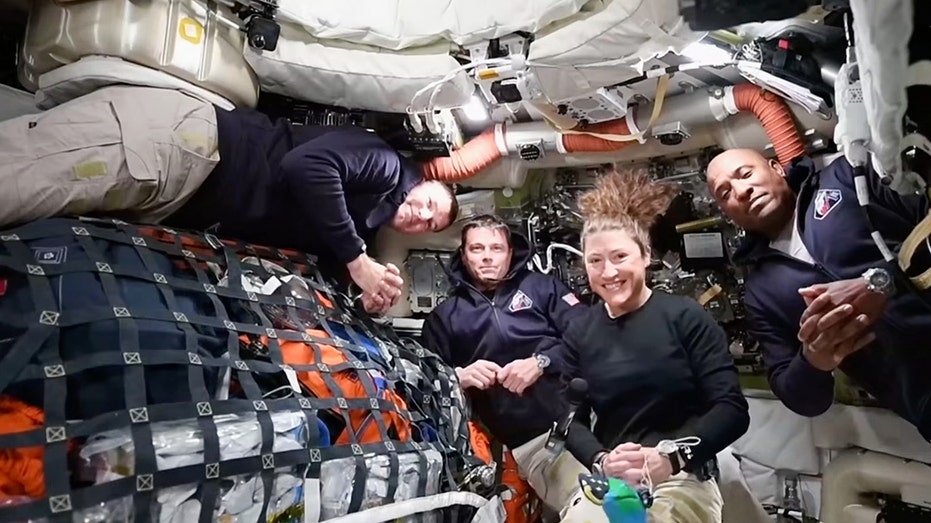
More than halfway on their historic journey around the moon, the four American astronauts aboard NASA’s Artemis II mission are getting a firsthand reminder that space travel is still a test of grit, ingenuity, and American determination. After launching from Kennedy Space Center in Florida on Wednesday, the crew is pressing forward despite dealing with a malfunction involving Orion’s onboard toilet system.
The issue, while drawing understandable public interest, is not threatening the mission. NASA officials have emphasized that systems remain operational, redundancy is in place, and the astronauts are safe as the spacecraft continues its voyage toward lunar orbit.
A Familiar Challenge in Space
For the second time since liftoff, engineers and astronauts have had to troubleshoot Orion’s waste management system. According to Artemis II Flight Director Judd Frieling, the problem surfaced when the crew attempted to vent the wastewater tank connected to the toilet.
Mission controllers suspect a blockage, potentially caused by ice formation, is preventing proper venting. Ice buildup is not uncommon in the extreme conditions of space, where temperature swings can be severe and hardware must function in an unforgiving vacuum.
As a precaution, the astronauts were instructed to switch overnight to collapsible contingency urine devices—backup tools specifically designed for situations like this. These portable systems ensure crew health and mission continuity even when primary components experience hiccups.
Importantly, NASA officials confirmed that the toilet remains usable for solid waste. The system is not fully offline, and the mission is continuing on schedule.
This Is Exactly Why It’s a Test Flight
Artemis II is not just a symbolic return to deep space—it is a critical proving ground for America’s next generation of lunar exploration systems. Managed by NASA’s Orion Program, the mission is designed to validate life-support, navigation, communications, and habitat systems before astronauts attempt an actual lunar landing on a future Artemis mission.
Debbie Korth, Orion program deputy manager, noted that this is precisely what a test flight is meant to uncover.
“This is a test flight. We're figuring out how these systems work together,” Korth explained. “It is operable, and we have redundancy to get us through the mission.”
Redundancy is a cornerstone of American space engineering. Critical systems are designed with backup capabilities because, miles from Earth, there is no calling a repair truck. Every possible scenario must be anticipated.
The Artemis program itself represents America’s determined push to reassert leadership in human space exploration. Administered through NASA’s Artemis initiative, this multi-mission effort aims to establish a sustainable American presence on and around the moon, paving the way for eventual crewed missions to Mars.
The Reality of Space Bathrooms
If there’s one aspect of spaceflight the public immediately gravitates toward, it’s how astronauts handle everyday human needs in zero gravity.
John Honeycutt, chair of the mission management team, acknowledged that people are naturally curious about space bathrooms.
“Everybody knows how important that is to us here on Earth, and it's harder to manage in space,” he said.
Indeed, designing a working toilet in space is vastly more complicated than most Americans realize. On Earth, gravity does the work. In orbit—or on a free-return trajectory around the moon—everything floats. Waste systems must use airflow, suction, filters, and storage tanks to safely collect and manage material without contaminating the cabin.
NASA has decades of experience developing these systems, including those used on the International Space Station. Still, each spacecraft design introduces new engineering variables. Orion’s compact capsule layout and deep-space mission profile present unique challenges distinct from Earth-orbiting stations.
Odor Concerns and Crew Professionalism
In addition to the venting problem, astronauts reported an unusual smell originating from the bathroom unit, located in the floor of the capsule. Astronaut Christina Koch alerted mission control to what she described as a burning heater-like odor coming from the toilet area.
Such reports are taken seriously. In a sealed spacecraft environment, air quality is mission-critical. Orion’s Environmental Control and Life Support System (ECLSS) continually monitors cabin atmosphere composition, temperature, and humidity to ensure astronaut safety.
So far, NASA officials have indicated there is no danger to the crew, and atmospheric systems are functioning as designed. The reported smell appears connected to the hardware anomaly rather than posing a broader environmental threat inside the spacecraft.
This kind of real-time communication between astronauts and ground teams demonstrates the professionalism and discipline that define American space operations.
Camping in Space—A Test of Fortitude
Honeycutt described the situation as a bit like “camping in space.” While that may sound lighthearted, the analogy underscores the resilience required of astronauts on missions like Artemis II.
Limited space, constrained resources, and an inability to step outside for fresh air all require mental toughness. These men and women are not just passengers—they are test pilots for humanity’s next frontier.
The hallmark of NASA’s astronaut corps has always been adaptability. From the early Mercury missions chronicled by Project Mercury through Apollo and the Shuttle era, American astronauts have consistently shown that minor mechanical obstacles are no match for preparation and training.
The Bigger Picture: America’s Return to the Moon
It is worth remembering what Artemis II represents. The last time American astronauts traveled to the moon was during Apollo 17 in 1972. More than five decades later, the United States is returning not just for a symbolic visit, but to build a long-term presence.
The Artemis campaign includes:
- Establishing a lunar-orbiting habitat known as Gateway
- Developing sustainable surface exploration systems
- Testing technologies for future crewed missions to Mars
- Strengthening American leadership in space amid rising global competition
With rival nations expanding their own lunar programs, maintaining American dominance in space is not simply about prestige. It is about national security, economic opportunity, and technological advancement.
Every system tested aboard Orion—including the toilet—contributes valuable data. Even minor malfunctions provide engineers with insights that will protect future crews.
Engineering for the Harshest Environment Known to Man
Space remains one of the most hostile environments humans have ever attempted to navigate. Temperatures swing hundreds of degrees between sunlight and shadow. Radiation levels increase dramatically beyond Earth’s protective magnetosphere. Microgravity impacts everything from fluid flow to muscle mass.
Within this context, a temporary plumbing issue—while inconvenient—is not mission escalation territory. It is part of the intricate testing process required before astronauts eventually land on the lunar surface again.
Orion itself is designed for deep space operations far beyond what previous crew capsules experienced. According to NASA’s official Orion overview page, the spacecraft is built to withstand reentry speeds of approximately 25,000 miles per hour when returning from the moon.
A waste system hiccup is a manageable technical problem compared with the nuclear-level heat the capsule must endure on its journey home.
The Media Spotlight and Public Fascination
There is a reason stories about space toilets capture headlines. They make distant, complex missions feel relatable. Everyone understands the discomfort of a plumbing problem.
But it is important to maintain perspective. The Artemis II crew is performing high-level spacecraft operations, orbital corrections, system tests, and biomedical monitoring—all while millions watch from Earth.
The focus on the bathroom, as Honeycutt suggested, is simply human nature. What truly matters is that NASA engineers anticipated potential failures and equipped the crew with backup solutions.
Looking Ahead to Lunar Orbit
Orion is on course to enter lunar orbit on Monday before executing its return trajectory back to Earth. The mission follows a free-return path, meaning the spacecraft uses the moon’s gravity to slingshot back home without requiring complex propulsion burns for return.
This tried-and-true trajectory enhances safety—another example of the rigorous planning behind Artemis II.
If successful, the mission will clear the way for future Artemis flights that may include actual lunar landings. Each test validates systems, identifies weak points, and strengthens hardware for the next generation of exploration.
American Leadership in Space Is Built on Perseverance
From the days of President John F. Kennedy’s moon challenge to today’s renewed lunar ambitions, American space dominance has been defined not by perfection, but by perseverance.
Small problems do not derail American missions. They improve them.
The Artemis II astronauts are demonstrating calm, competence, and commitment as they manage this inconvenience. Meanwhile, engineers at mission control are gathering data that will refine future spacecraft designs.
That is how progress works. That is how America leads.
A Minor Hiccup in a Major Milestone
At its core, this toilet malfunction is a footnote in an otherwise bold and inspiring chapter of American innovation. The crew remains safe. The spacecraft continues on course. The mission objectives are intact.
And as Orion approaches its lunar orbit, one thing is clear: America is back in deep space.
The Artemis program is not about avoiding every minor inconvenience. It is about pushing humanity forward—carefully, deliberately, and boldly.
A temporary plumbing problem cannot overshadow what this mission represents: a determined nation reclaiming its role as the world’s leader in space exploration.
Stay tuned. The moon awaits—and America is answering the call once again.
Wake Up America News
Your Source for Patriotic News