Artemis II Crew Returns Home After Historic Journey Around the Moon
After a successful 10-day voyage around the Moon and back, the four astronauts of NASA’s Artemis II mission returned to Earth with more than mission data — they brought home a renewed sense of unity, purpose, and hope for the future of American space leadership.
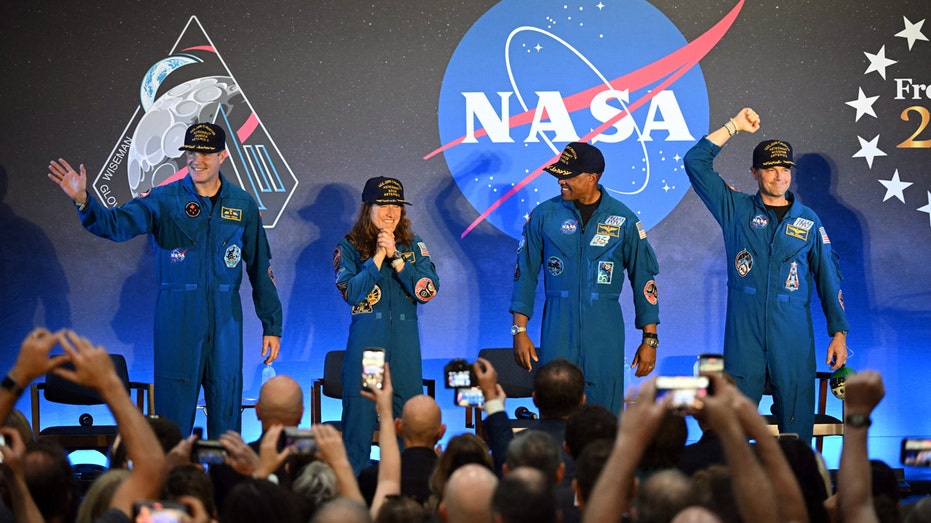
Just one day after splashing down safely in the Pacific Ocean off the coast of California, the crew stood before a welcoming crowd at Ellington Field Joint Reserve Base near Houston, Texas, where they offered heartfelt reflections on their journey beyond low Earth orbit. It was a moment that symbolized more than the end of a mission; it marked America’s bold return to deep space exploration after more than half a century.
Commander Reid Wiseman, Pilot Victor Glover, Mission Specialist Christina Koch, and Mission Specialist Jeremy Hansen are now forever linked as the first astronauts to travel around the Moon since the Apollo era. Their trip represents a pivotal step in the larger Artemis program, NASA’s ambitious initiative to return humans to the lunar surface and ultimately prepare for missions to Mars.
“Bonded Forever” After a Journey Beyond Earth
Commander Reid Wiseman described the profound emotional shift that comes from seeing Earth from such a vast distance.
“It’s a special thing to be human, and it’s a special thing to be on planet Earth,” Wiseman said, reflecting on the stunning view of our home world shrinking to a small sphere in the darkness of space.
He emphasized that shared adversity and accomplishment forged an unbreakable connection among the crew. After flying at speeds exceeding Mach 39 during reentry, enduring isolation in deep space, and navigating the immense responsibility placed upon them, the astronauts embraced on stage — a visible symbol of their statement that they are now “bonded forever.”
For Americans watching at home, the message was powerful. This was not simply a technological feat. It was a reminder that courage, discipline, and teamwork remain defining characteristics of the American spirit.
NASA’s Return to the Moon After 53 Years
NASA leadership underscored the historic importance of the moment. Artemis II marked the first time astronauts traveled beyond low Earth orbit since Apollo 17 in 1972. That 53-year gap represents an entire generation of Americans who had never witnessed a crewed mission beyond Earth’s immediate neighborhood.
According to NASA Administrator Jared Isaacman, the mission signals a decisive return to lunar exploration.
“After a brief 53-year intermission, the show goes on,” Isaacman said. “NASA is back in the business of sending astronauts to the Moon and bringing them home safely.”
That statement carries weight. The Artemis II crew launched aboard NASA’s powerful Space Launch System (SLS) rocket and traveled in the Orion spacecraft, designed specifically for deep space missions. Unlike missions confined to low Earth orbit — such as those to the International Space Station — Artemis II ventured thousands of miles beyond, testing systems critical for future lunar landings.
The successful splashdown in the Pacific Ocean demonstrated that America’s next-generation space hardware works as intended. For taxpayers and policymakers alike, the safe return validated years of investment, research, and perseverance.
A Mission Measured in More Than Miles
While the technical achievements are significant, the Artemis II astronauts made clear that the mission’s impact goes deeper than engineering milestones.
Pilot Victor Glover spoke openly about the emotional magnitude of the experience. He expressed gratitude to God and acknowledged the difficulty of fully processing what the crew experienced.
Seeing Earth from lunar distance has historically reshaped astronauts’ perspectives. During the Apollo missions, images like “Earthrise” permanently altered humanity’s understanding of its place in the cosmos. Artemis II now adds a new chapter to that legacy.
Mission Specialist Christina Koch offered one of the most poignant reflections of the event. She described the journey as bookended by simple human interactions — a quiet wake-up call announcing launch readiness and a caring nurse helping her rest after splashdown.
Those grounded, everyday moments provided contrast to the awe-inspiring view of Earth suspended in the vast blackness of space.
Earth as a “Lifeboat” in the Darkness
Koch said that when she looked out the Orion spacecraft window, it was not just Earth that captured her attention. It was the overwhelming darkness surrounding it.
She likened our planet to a “lifeboat” floating in a sea of blackness — a powerful metaphor that resonated with many Americans listening.
In her words, a “crew” is more than a team assigned to a task. It is a group of individuals united in sacrifice, accountability, mutual responsibility, and shared purpose. She extended that definition beyond the spacecraft, suggesting that humanity itself forms a crew aboard the planet Earth.
This theme aligns with one of the enduring lessons of exploration: national strength and unity are vital when venturing into the unknown. Throughout American history — from the Apollo program to modern lunar missions — exploration has brought out the best in the nation.
International Partnership and Shared Achievement
Artemis II was also notable for including Canadian astronaut Jeremy Hansen, representing the Canadian Space Agency. His participation underscores the international dimension of the Artemis program.
However, the mission remains firmly rooted in American leadership. The United States designed and launched the spacecraft, coordinated mission control from the Johnson Space Center, and provided the infrastructure that made the mission possible.
Hansen emphasized the extraordinary level of preparation behind the scenes. Tens of thousands of engineers, technicians, medical personnel, and support staff contributed to Artemis II. Their meticulous training and oversight ensured that what the world saw as a smooth mission was backed by years of disciplined effort.
Hansen noted that the astronauts on stage were, in many ways, a reflection of the broader team — and by extension, the citizens who support space exploration through their tax dollars and their belief in America’s pioneering spirit.
Economic and Technological Impact at Home
NASA leadership also stressed the tangible returns on investment from space exploration.
Deep space missions drive innovation across multiple industries, including:
- Advanced manufacturing and materials science
- Medical technologies developed for spaceflight health monitoring
- Artificial intelligence and autonomous navigation systems
- High-performance computing and communications infrastructure
- STEM workforce development for future generations
Historically, space exploration has yielded technologies that improve everyday life — from satellite communications and weather forecasting to innovations in imaging and materials. Artemis II continues that tradition.
Moreover, large-scale programs like Artemis support high-skilled American jobs across numerous states. Contractors, suppliers, and research institutions benefit from sustained funding tied to long-term exploration goals.
Strategic Importance of Returning to the Moon
The Artemis program is not solely about symbolism. It holds strategic implications for the United States.
As global competition in space intensifies, maintaining leadership in lunar exploration carries geopolitical significance. Establishing a sustained presence around and eventually on the Moon strengthens America’s position in shaping international norms and standards for space activity.
The Artemis Accords, a set of principles guiding peaceful cooperation in space exploration, reflect this forward-looking vision. By demonstrating capability and reliability through missions like Artemis II, the United States reinforces its role as the world’s premier spacefaring nation.
The Moon is increasingly viewed as a proving ground for technologies that will be required for human missions to Mars. Life support systems, deep-space navigation, radiation protection, and sustained habitation strategies must all be tested before pushing farther into the solar system.
Artemis II served as the critical crewed test flight that will pave the way for Artemis III, which aims to return astronauts to the lunar surface for the first time since 1972.
A Cultural Moment for a New Generation
For many Americans, Artemis II may serve as a defining memory — much like Apollo did for prior generations.
Children watching the splashdown or listening to the astronauts’ reflections saw more than a science lesson. They witnessed courage, discipline, and unity under pressure. They saw Americans pushing the frontier once again.
The emotional candor displayed by the crew added depth to the achievement. This was not bravado. It was humility born from staring into the vastness of space and returning safely home.
That balance — confidence paired with gratitude — reflects the best of the American character.
Safe Return: The Most Important Milestone
Exploration carries risk. NASA officials have long acknowledged that venturing beyond Earth’s protective magnetosphere exposes astronauts to increased hazards, from radiation to the unforgiving mechanics of high-speed reentry.
The success of Artemis II rests not only in reaching the Moon and flying around it, but in returning the crew safely to Earth. The splashdown in the Pacific Ocean marked the culmination of a complex series of operations involving recovery teams, naval coordination, and precision timing.
For Wiseman, Glover, Koch, and Hansen, the view of Earth growing larger in their spacecraft windows symbolized the mission’s ultimate priority: come home safely.
The Road Ahead
Artemis II is not the finale — it is the opening act of a new era.
The next missions under the Artemis banner aim to land astronauts near the lunar south pole, build a sustainable presence, and develop the infrastructure necessary for deeper exploration. Efforts such as the planned Lunar Gateway space station will expand America’s operational reach beyond low Earth orbit.
If Artemis II proved anything, it is that the United States retains both the capability and the will to lead in space.
The astronauts’ reflections at Ellington Field were not merely ceremonial remarks. They were reminders that space exploration connects technological excellence with human purpose.
From the vast darkness of lunar orbit to the safety of home soil in Texas, the Artemis II crew’s journey stands as a testament to American resolve. After more than five decades away from deep space, our nation has once again shown it can venture outward — and return stronger.
As Commander Wiseman and his crewmates made clear, they may be bonded forever. But in many ways, so is the nation that sent them.
And for a country built on exploration, innovation, and faith in the future, that bond may be the most powerful achievement of all.