Another Close Call at Louisville Airport Raises Fresh Questions About Aviation Safety
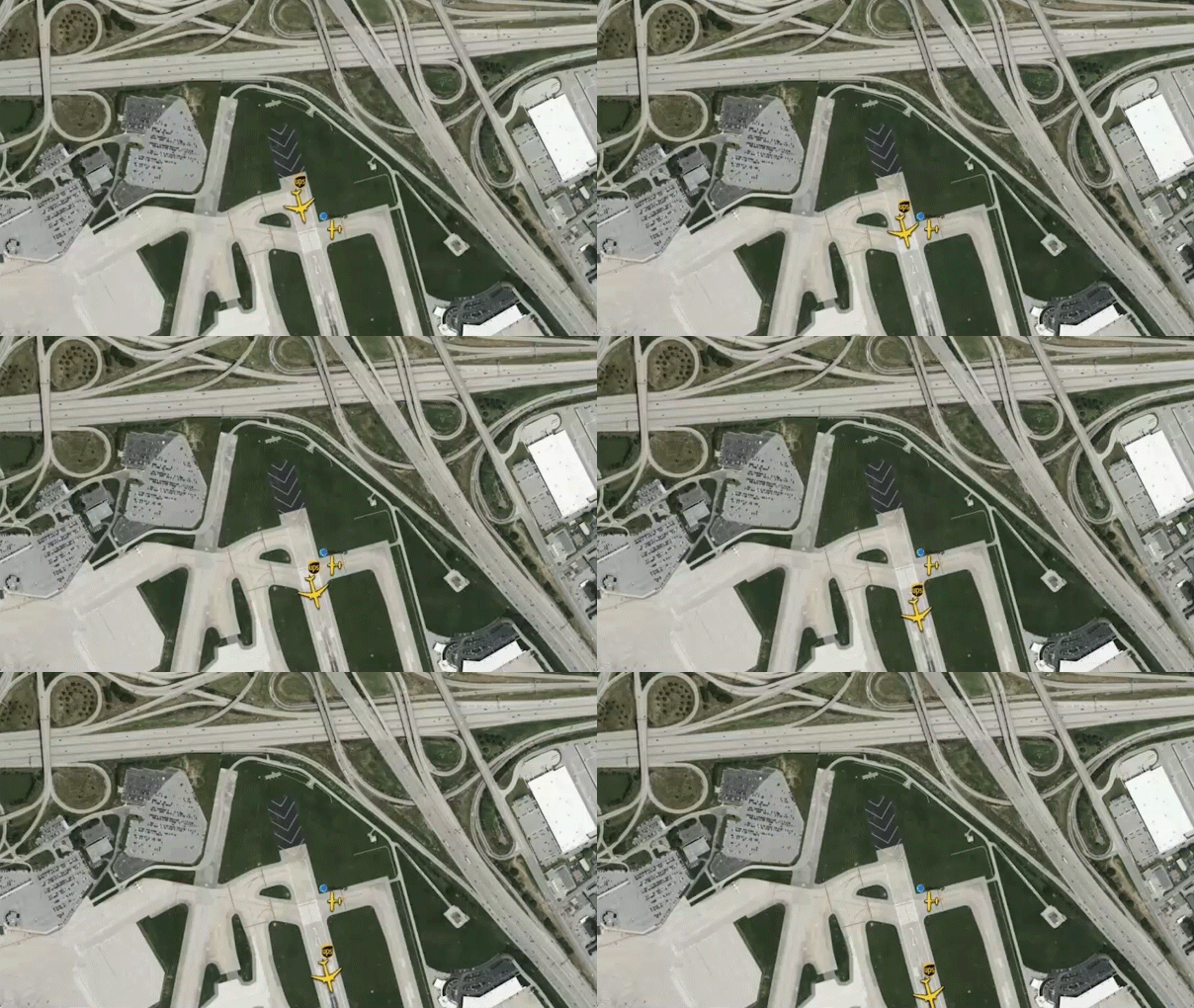
A UPS cargo jet was forced to abruptly abort its landing at Louisville Muhammad Ali International Airport this week after a smaller aircraft entered the runway without authorization—triggering a tense exchange with air traffic control and renewing scrutiny at an airport still recovering from a devastating crash just months ago.
The incident, while resolved safely, highlights ongoing concerns about runway incursions and operational discipline at one of America’s busiest cargo hubs. It also comes against the painful backdrop of a November tragedy at the very same airport that claimed 15 lives, making this near miss feel far more significant than a routine aviation event.
What Happened in the Air
The aircraft involved was UPS Flight 1303, a Boeing 767 cargo jet arriving from Atlanta in the early morning hours. As the aircraft was descending toward the runway, a smaller plane identified in air traffic control communications as “Skylab 25” turned onto the runway without clearance.
According to the Federal Aviation Administration (FAA), air traffic control quickly instructed the UPS crew to perform a go-around—a maneuver in which a pilot discontinues landing and climbs back into the air to attempt another approach.
Audio from the control tower captured the urgency of the moment. At one point, a controller can be heard shouting, “Two-Five, stop!” followed by, “SkyLab Two-Five, what are you doing?”
Moments later, the UPS aircraft was directed to climb and circle back. Flight tracking data from FlightRadar24 indicated that the jet had descended to roughly 500 feet before initiating a rapid climb to approximately 1,500 feet.
The FAA stated that required separation between the aircraft was maintained and that safety margins were never compromised. That is crucial—but it does not erase the fact that unauthorized runway entries can prove catastrophic under slightly different circumstances.
Standard Procedure—but Still a Serious Event
A go-around is a routine and well-practiced part of aviation. Pilots regularly train for the maneuver, and commercial crews are expected to execute it decisively whenever runway safety is in question.
UPS confirmed that its crew followed standard operating procedure.
“Following standard procedures, a UPS aircraft safely conducted a go-around during its approach at the direction of air traffic control. There was no operational impact,” the company said in a statement.
From a technical standpoint, the system functioned as designed:
- Air traffic control detected a problem.
- Clear and urgent instructions were issued.
- The UPS crew complied immediately.
- Safe altitude separation was maintained.
But the broader question remains: why was another aircraft on the runway without authorization in the first place?
Runway incursions—defined by the FAA as any unauthorized presence on an active runway—are considered among the most serious safety threats in aviation. In recent years, the FAA has increased focus on preventing such incidents nationwide.
The Importance of Louisville’s UPS Worldport
Louisville is not just another regional airport. It is home to UPS Worldport, the company’s global air hub and the beating heart of its international logistics operation.
The massive 5.2 million-square-foot facility processes hundreds of thousands of packages daily and connects cargo routes across North America, Europe, Asia, and Latin America. Every night, fleets of aircraft converge on Louisville in a tightly choreographed operation that depends on precise timing and flawless coordination.
Given that scale, the margin for operational error is small—and the stakes are enormous.
Any misstep involving runway access at a hub like Worldport can have ripple effects that extend far beyond Kentucky. It can disrupt supply chains, delay critical medical shipments, and affect businesses and consumers nationwide.
A Painful Reminder of November’s Deadly Crash
This latest incident cannot be separated from the tragedy that struck Louisville in November 2025.
A UPS McDonnell Douglas MD-11 cargo aircraft crashed shortly after takeoff from the same airport, killing all three crew members and 12 individuals on the ground.
The National Transportation Safety Board (NTSB), which is leading the investigation, determined in preliminary findings that the left engine detached shortly after takeoff. The engine reportedly caught fire, and structural failure in the mounting system was cited as a likely contributing factor.
The aircraft climbed only about 30 feet above the ground before plummeting back down.
Surveillance footage showed the engine separating from the wing before impact. Subsequent analysis revealed structural cracks in the engine mount assembly—raising urgent questions about inspection protocols and maintenance oversight.
In response:
- UPS grounded its MD-11 fleet.
- The FAA ordered additional inspections and maintenance directives.
- Investigators launched a comprehensive review of maintenance records and structural certification standards.
For the Louisville community, the scars of that crash remain fresh. Families are still grieving. Investigations are ongoing. And the memory of a fireball near the runway lingers in the minds of airport workers and residents alike.
Runway Incursions: A Nationwide Concern
This week’s incident fits into a broader national conversation about aviation near misses.
In recent years, several high-profile runway close calls have made headlines, prompting the FAA to implement a “Safety Call to Action” aimed at reinforcing procedures and improving situational awareness in air traffic control towers.
According to FAA data, while the overwhelming majority of flights operate safely, runway incursions still occur multiple times per year across the country. Most do not result in accidents—but history shows that when they do, the consequences can be devastating.
Runway safety depends on:
- Clear communication between pilots and controllers
- Strict adherence to taxi and runway instructions
- Situational awareness in high-traffic environments
- Reliable radar and ground surveillance systems
Louisville’s role as a 24-hour cargo hub adds complexity to the environment. Operations often intensify during nighttime hours, when cargo banks converge and aircraft movement is at its peak.
The Critical Role of Professional Training
One reason this event did not end in tragedy is the professionalism of the UPS flight crew and the tower controllers involved.
Commercial airline crews undergo extensive simulator training that includes scenarios involving obstructed runways, sudden weather changes, and equipment malfunctions. The ability to execute a go-around instantly is not accidental—it is a core competency drilled repeatedly throughout a pilot’s career.
Similarly, air traffic controllers train for high-pressure decision-making under strict federal standards set by the FAA.
In this case, the system worked:
- The controller identified the unauthorized runway entry.
- An assertive command to stop was issued to the smaller aircraft.
- The UPS jet was instructed to climb before any danger materialized.
In aviation, decisive communication saves lives. This week, it likely did.
A Separate Small Plane Incident in Kentucky
Compounding aviation concerns in the region, a separate incident occurred near Blue Grass Airport in Lexington just days earlier.
A small propeller aircraft landed in a field near the airport. Fortunately, both occupants were unharmed.
While unrelated to the Louisville near miss, the Lexington incident serves as a reminder of how varied and unpredictable general aviation events can be. Unlike large airlines, smaller private aircraft operations can involve different levels of pilot experience and aircraft systems.
The Bigger Picture: Confidence in American Aviation
America remains home to the safest aviation system in the world. The United States manages tens of thousands of flights daily across commercial, cargo, military, and private sectors. The layered safety systems—pilot training, air traffic control oversight, aircraft maintenance regulations, and federal investigation protocols—have made catastrophic accidents exceedingly rare compared to earlier decades.
But safety is never static.
The November crash underscored the importance of rigorous aircraft inspection standards and structural integrity oversight. This week’s runway close call highlights the human factors dimension—communication discipline and procedural compliance.
Both elements matter.
For communities like Louisville, which sit at the heart of global logistics networks, aviation safety is not abstract. It affects local jobs, economic stability, and daily life.
What Comes Next?
The FAA is expected to review the runway incursion incident in detail. Such reviews typically include:
- Evaluation of radio communications
- Analysis of radar data
- Interviews with flight crews and controllers
- Assessment of any procedural breakdowns
If errors occurred, corrective steps may include additional training, revised procedures, or disciplinary action depending on findings.
Meanwhile, the NTSB investigation into November’s deadly crash continues. Final reports often take many months to complete, as investigators reconstruct mechanical failures and analyze maintenance histories in detail.
The American public deserves transparency in both cases.
A System That Must Remain Vigilant
This week’s aborted landing ended with no injuries, no damage, and no disruption to operations. That is good news—and a testament to the safeguards embedded in American aviation.
But close calls are warnings as much as they are relief stories.
At a time when supply chains underpin national economic strength and cargo hubs like Louisville serve as arteries of American commerce, maintaining rigorous standards is non-negotiable.
The lessons from November are still unfolding. The message from this week is clear: vigilance cannot slacken—not on the runway, not in maintenance hangars, and not in control towers.
America’s aviation system is strong because it learns from mistakes and corrects them. That culture of accountability must remain front and center.
For the families affected by last year’s tragedy, and for the millions of Americans who depend on safe and reliable air transport every day, that commitment to safety is not just a policy priority—it is a moral obligation.
At Louisville Muhammad Ali International Airport, the margin between routine operations and catastrophe has been tested twice in less than a year. This time, experience and professionalism prevailed.
Now comes the responsibility to ensure that next time, there isn’t even a close call.