Shreveport Reels After Domestic Massacre Leaves Eight Children Dead
The city of Shreveport, Louisiana is facing one of the darkest chapters in its history after authorities identified the man responsible for a devastating domestic violence rampage that left eight children dead and multiple adults injured early Sunday morning. Police say the suspect, Shamar Elkins, carried out a series of violent acts across multiple locations before being killed in a confrontation with law enforcement.
According to the Shreveport Police Department, seven of the young victims are believed to have been Elkins’ own children. Their ages reportedly ranged from approximately one year old to 14 years old. An eighth child was also killed in the attack, making this one of the most horrific domestic violence massacres in recent Louisiana history.
Two women were also shot during the rampage—one of them believed to be the mother of Elkins’ children. Authorities say she is expected to survive. Another woman remains in critical condition with life-threatening injuries. A teenage victim sustained non-life-threatening wounds.
This tragedy has not only shaken Northwest Louisiana—it has sparked renewed national concern about the destructive power of domestic violence and the vulnerability of children caught in its path.
A Timeline of Violence Across Multiple Crime Scenes
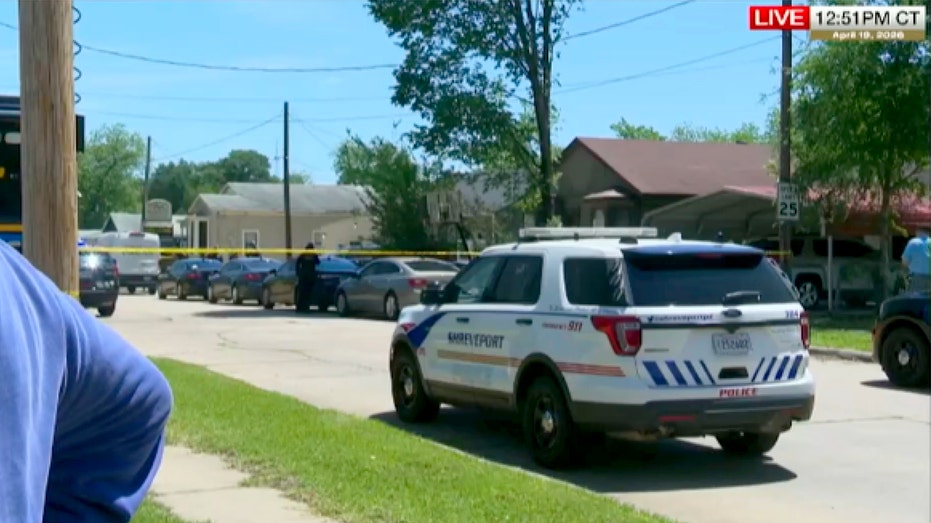
Investigators say the violence unfolded in stages, beginning on Harrison Street in Shreveport. Elkins allegedly shot a woman at that location before traveling to a residence on West 79th Street, where the murders of the eight children occurred.
Authorities describe the crime scene as “extensive” and emotionally overwhelming even for seasoned officers. Corporal Christopher Bordelon of the Shreveport Police Department called it a “heinous crime” during remarks to reporters.
After the attacks at the residence, the suspect fled the area. Police say he carjacked a man at gunpoint near the intersection of Linwood Avenue and West 79th Street. That stolen vehicle was later located by law enforcement, triggering a multi-agency pursuit.
The chase extended into neighboring Bossier Parish, where officers ultimately confronted Elkins. During that encounter, officers opened fire, fatally shooting him at the scene. Authorities report that no officers were injured.
The Louisiana State Police have taken over the investigation into the officer-involved shooting, which is standard protocol in such cases. Meanwhile, Shreveport police continue to investigate the murders and are urging anyone with additional information, photos, or video to come forward.
Leadership Responds: “A Terrible Morning” for Shreveport
Shreveport Police Chief Wayne Smith expressed visible shock as he addressed the press.
“I just don’t know what to say. My heart is just taken aback,” Smith said. “I cannot begin to imagine how such an event could occur.”
Shreveport Mayor Tom Arceneaux described the attack as possibly the worst tragedy the city has ever endured, calling it “a terrible morning” for the community.
City Councilman Grayson Boucher emphasized how profoundly the single act of violence altered the city’s crime statistics overnight.
“We more than doubled our homicides in the city of Shreveport because of one act of domestic violence,” Boucher stated. He further noted that roughly 30 percent of violent crimes in the city are domestic-related, highlighting a troubling trend that stretches far beyond this single case.
House Speaker Mike Johnson, who represents Louisiana’s 4th Congressional District, offered prayers and support for the grieving community. He confirmed his office was in contact with local authorities as more details emerged, thanking law enforcement for their swift response.
A Domestic Crisis with National Implications
While this massacre is local in geography, the underlying issue is national in scope. According to the U.S. Department of Justice Office on Violence Against Women, domestic violence remains one of the most persistent and deadly threats facing families across America. Children are often silent victims—either as direct targets or as witnesses to unimaginable trauma.
Domestic violence cases frequently escalate in cycles. Experts point to warning signs such as:
- Prior threats or intimidation within the household
- History of controlling or possessive behavior
- Previous incidents of physical or emotional abuse
- Access to firearms during active domestic disputes
Local officials stressed that early intervention is critical, though it is often easier said than done. Councilwoman Tabatha Taylor warned that dismissing warning signs can lead to catastrophic consequences.
“This is real,” she said. “And this is the result when someone snaps.”
The Children: Innocent Lives Lost
At the heart of this tragedy are the eight children whose lives were cut short. Authorities have not released their names publicly, honoring the ongoing investigation and the privacy of surviving family members.
What is known is heartbreaking enough: most were believed to be the suspect’s own children. They were toddlers, elementary school students, and teenagers—young Americans who had their entire futures ahead of them.
Child advocacy groups routinely emphasize that children trapped in volatile homes often lack the power or resources to protect themselves. Incidents like this serve as a sobering reminder that protecting children requires vigilance not just from authorities, but from neighbors, schools, faith communities, and extended families.
Suspect’s Background Raises Questions
Authorities confirmed that Shamar D. Elkins previously served in the Louisiana Army National Guard from August 2013 to August 2020. According to an Army official, he worked as a Signal Support Systems Specialist (25U) and a Fire Support Specialist (13F). He was never deployed and left the service as a private.
While military service in itself does not suggest violent behavior—indeed, millions of honorable Americans serve with distinction—it inevitably raises questions about whether warning signs existed and whether adequate support systems were in place after separation from service.
The vast majority of National Guard members serve honorably and reintegrate into civilian life successfully. Still, tragedies like this prompt discussions about mental health services, domestic instability, and crisis intervention options for veterans and service members transitioning back into their communities.
The Broader Domestic Violence Challenge
Domestic violence remains a persistent reality in American communities of all sizes. According to federal data compiled by agencies such as the Bureau of Justice Statistics, intimate partner violence accounts for a significant portion of violent crime in the United States each year.
Local leaders in Shreveport noted that domestic violence cases comprise a substantial share of the city’s violent crime calls. When disputes escalate behind closed doors, outcomes can be fatal—and often unfold before authorities even have a chance to intervene.
There are typically three areas where intervention can make a measurable difference:
- Early reporting: Encouraging victims or witnesses to come forward before violence escalates.
- Protective orders: Utilizing court-issued orders to create legal distance between aggressors and victims.
- Community engagement: Churches, schools, and civic institutions recognizing red flags and acting proactively.
Yet domestic violence remains uniquely difficult to stop, in part because it occurs in private spaces—often shielded from public accountability until tragedy strikes.
Law Enforcement Praised for Swift Response
Officials across jurisdictions credited Shreveport police, Bossier Parish deputies, and Louisiana State Police with acting swiftly to stop further bloodshed. Once the suspect fled the murder scene and committed a carjacking, the situation had the potential to spiral even further.
The rapid vehicle pursuit and coordination between agencies prevented what could have been additional casualties. In crisis situations, interagency communication and decisive action are critical. Sunday’s confrontation, while deadly, ended the threat to the broader community.
As the Louisiana State Police conduct their independent investigation into the officer-involved shooting, transparency and accountability will remain key to maintaining public trust.
A City Searching for Answers
Community members across Shreveport are grappling with disbelief and grief. Churches opened their doors for prayer services. Neighbors gathered in hushed clusters. Local officials described the emotional toll as immediate and overwhelming.
Beyond the investigation, many are asking broader questions:
- Were there prior reports of domestic disturbance?
- Were protective orders or warning signs present?
- What resources were—or weren’t—utilized?
Such questions are a natural part of the healing process. They are not about political talking points, but about preventing the next tragedy.
A Call for Vigilance and Community Responsibility
As Americans, we value family, faith, and the protection of our children above all else. When violence erupts within the home itself, it strikes at the very foundation of society.
This tragedy in Shreveport is a grim reminder that domestic violence is not a distant issue confined to statistics. It is a lived reality that devastates families and reshapes communities overnight.
Officials are urging residents to remain vigilant and to report credible threats to law enforcement. The old assumption that domestic disputes are “private matters” can no longer stand when lives—especially children’s lives—are at risk.
Anyone with information related to the investigation is being asked to contact the Shreveport Police Department directly.
Prayers, Accountability, and Prevention
In moments like this, politics fades and humanity comes into focus. Eight innocent children are gone. Two women are recovering from gunshot wounds. A city is left picking up the pieces.
America has long upheld the principle that the most sacred responsibility of any society is to protect its children. That means strengthening families, supporting those in crisis, empowering law enforcement, and refusing to ignore warning signs when they appear.
Shreveport now faces the hard road of mourning, investigation, and reform. For the rest of the nation, this tragedy serves as a solemn call: domestic violence left unchecked can destroy entire families in a single, irreversible moment.
The community’s grief is profound. But so too is its resilience. In the days ahead, prayer vigils will be held, investigations will continue, and difficult conversations will unfold. The priority must remain clear—honor the lives lost, care for the wounded, support the grieving, and take meaningful steps to ensure such horror does not happen again.
For now, Shreveport mourns. And America watches, prays, and remembers eight young lives stolen far too soon.